Thesis and article · UC · 2017
A harvesting vehicle that runs on sunlight alone
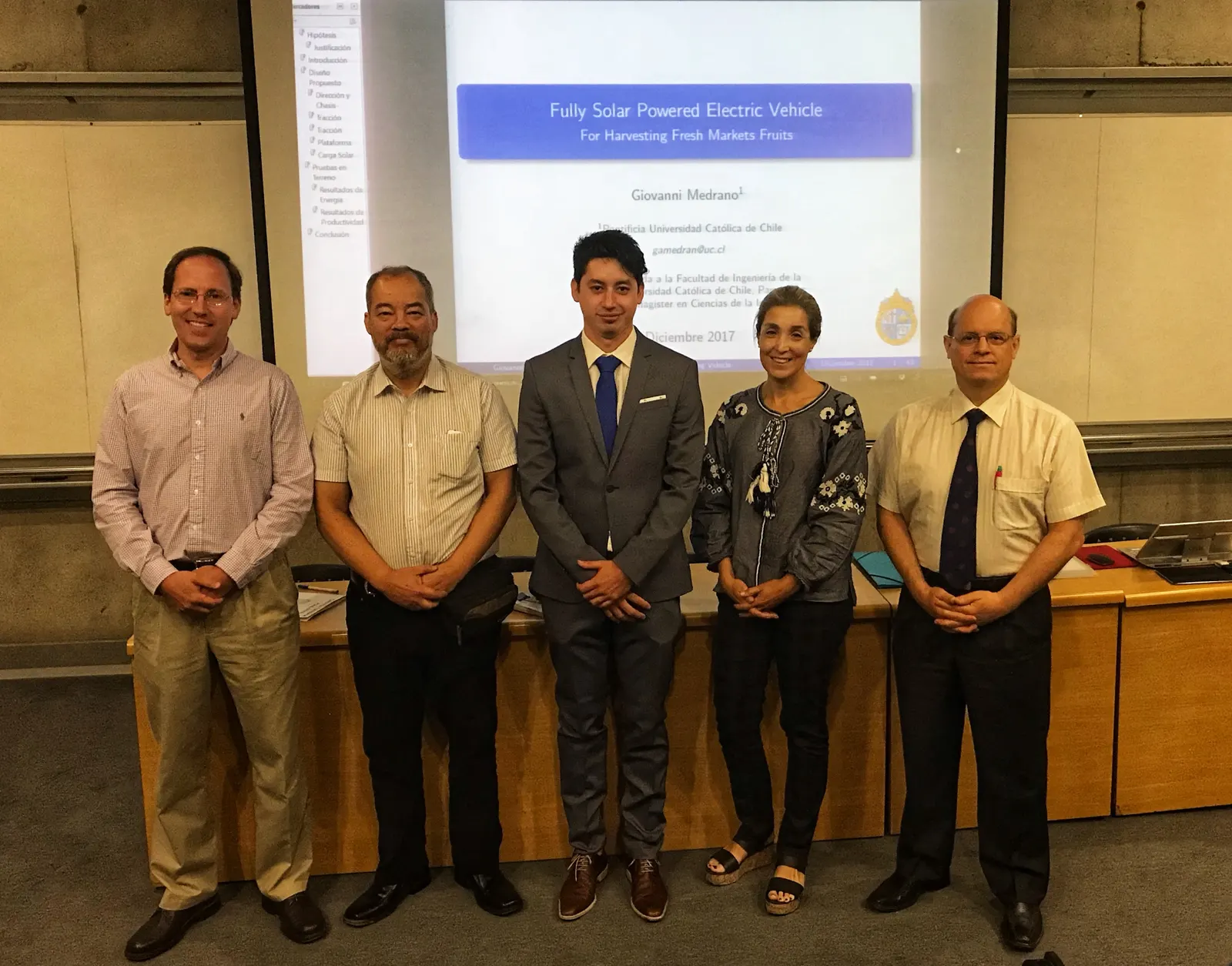
For an M.Sc. in Engineering at Pontificia Universidad Católica de Chile, Gio Medrano designed, built and tested in commercial orchards an electric vehicle for harvesting export fruit that runs on solar energy alone. This is a summary of the thesis and the accompanying article.
- < 20%
- of battery used over a full harvest day, without plugging in
- 7 + 1,000 kg
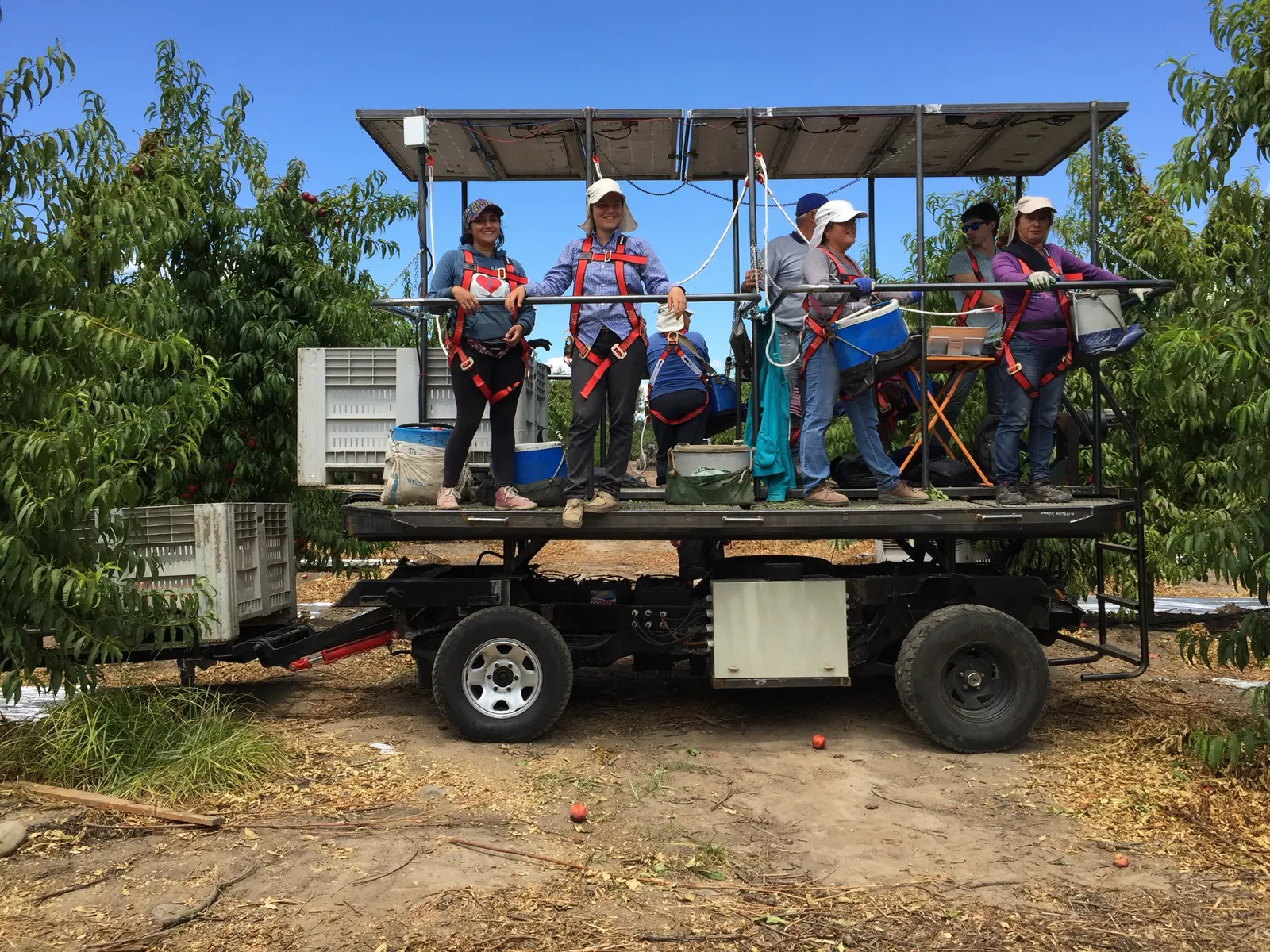
- a crew of seven and two 500 kg bins on board
- 192 vs 70 kg
- of cherries per person per day in the best trial, versus the usual on foot
- 973 vs 800 kg
- of nectarines per person per day by the second trial day
The problem
Export cherries and nectarines are picked by hand, because a bruise only shows once the fruit reaches Asia. In a typical orchard the crew works on ladders over three meters tall: climb, pick, climb down, move the ladder and walk to deliver the bucket. According to the literature cited in the article, hand picking accounts for 46% of the total cost of producing cherries.
The alternatives did not fit Chilean orchards: shakers damage fruit and trees, robotics was not ready, and imported platforms are expensive, poorly suited to local orchards and run on combustion engines.
The machine
An electric platform designed and built for the thesis. It carries eight solar panels (750 W nominal across about 6 m²) over a bank of deep-cycle batteries, a 5 kW brushless motor with dynamic braking, and four-wheel steering to turn at the ends of rows in a dense orchard. It carries 1,500 kg and can be driven by remote control.
The key idea is the work cycle: the vehicle moves forward its own length on battery and stops; while the crew picks, the panels replace the energy spent. That way it can repeat the cycle all day without plugging in.
The trials
It was tested over two seasons in commercial orchards: cherries in Aculeo, Rancagua and Molina in December 2015, and nectarines in Coltauco in January 2017, thanks to Agrícola Vergara, Agrícola Miguel Vial and Agrícola Garcés. Street tests first measured consumption, range (10.16 km at 7.35 km/h on a slope) and solar recharge time.
Even with an untrained crew, productivity was always equal to or better than picking on foot. With cherries, the best trial more than doubled the usual output. With nectarines, the crew cut each stop to 30 seconds by the second day. And because the work takes less physical effort, women and older workers could join the crew.
What it has to do with AgroSynapse
The thesis did not stop at the prototype: every conclusion came from measuring battery state, current, and kilos per person per hour in the orchard. That same habit is the basis of AgroSynapse: a cost per block is only useful if every figure comes from a real record and can be traced to its source.
The article left two open lines: measuring the effect on fruit quality, and adding computer vision to harvesting vehicles. The second continues in AgroSynapse’s work with cameras and sensors in the field.
Reference
- Thesis
- Fully Solar Powered Electric Vehicle for Harvesting Fresh Market Fruits. Giovanni Medrano. M.Sc. in Engineering, Pontificia Universidad Católica de Chile, December 2017.
- Advisor
- Luciano E. Chiang
- Committee
- Luciano Chiang, Julio Vergara, Marlene Ayala, Juan Carlos Ferrer
- Article
- Chiang, L. E., Medrano, G. A. and Ayala, M. Fully solar powered electric vehicle for harvesting fresh market fruits.
- Funding
- Partly funded by the Regional Innovation for Competitiveness Fund (FIC-R) of the O’Higgins Region, project IDI 30343725-0.